Choosing a tennis racket is not only about brand or design. A racket affects power, control, spin, comfort, and how quickly a player can react during a rally. Two rackets can look similar but behave very differently because of their weight, head size, balance, string pattern, frame stiffness, and length.
Main types of tennis rackets
Tennis rackets are usually divided into several groups: power rackets, control rackets, tweener rackets, spin-friendly rackets, lightweight rackets, and junior rackets. Each type is designed for a different playing level and style.
Power rackets
Power rackets are made for players who need extra depth and speed without using too much physical effort. They usually have a larger head size, a lighter frame, and a thicker beam.
A larger head gives a bigger sweet spot. This means the ball can still travel well even when contact is not perfectly centered. Because of this, power rackets are often used by beginners, recreational players, and older players who want easier ball speed.
Typical features of power rackets include a head size from 105 to 115 square inches, a lighter weight, and a head-heavy balance. The frame helps generate pace, but the player gets less precision compared to a control racket.
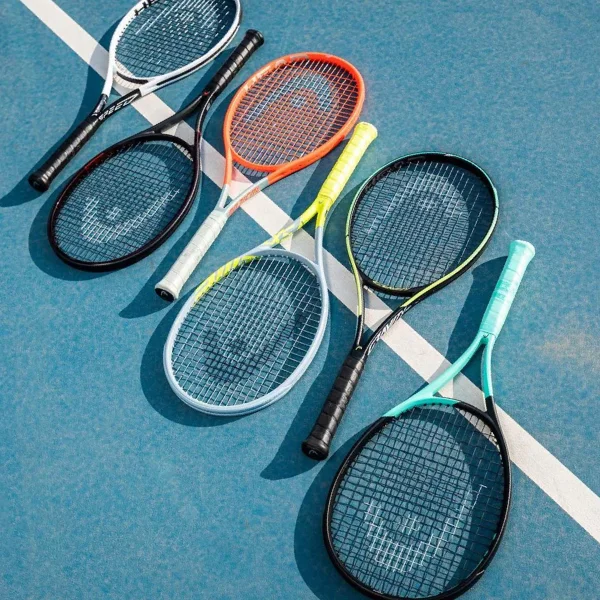
Power rackets are useful for players with compact swings. If a player does not take a long backswing, the racket still helps produce enough speed.
Control rackets
Control rackets are designed for advanced players who generate their own power. These rackets usually have a smaller head size, more weight, and a thinner frame.
A control racket does not add as much free power. Instead, it gives better accuracy and a clearer feel at contact. Players who hit fast and full strokes often prefer this type because they can aim closer to the lines without the ball flying too long.
Typical control rackets have a head size from 95 to 100 square inches. They are often heavier than beginner rackets and may have a more balanced or head-light setup. This makes them stable during fast exchanges and useful at the net.
Control rackets suit players who already have good timing, footwork, and technique. For beginners, they can feel demanding because off-center hits lose more speed.
Tweener rackets
Tweener rackets sit between power and control models. They are probably the most common choice for intermediate players because they offer a balanced mix of speed, spin, comfort, and accuracy.
A tweener racket usually has a head size around 100 square inches and medium weight. It gives enough help on groundstrokes but still allows the player to control direction and depth.
This type works well for players who are developing their game and do not want a racket that is too specialized. Many club players use tweener rackets because they perform well from the baseline, at the net, and on serve.
Spin-friendly rackets
Spin-friendly rackets are built for players who use topspin as a major part of their game. These rackets often have an open string pattern, such as 16×19, which allows the strings to move more and grip the ball better.
More string movement helps create higher rotation. This can make the ball dip faster into the court and bounce higher after landing. Players who hit heavy topspin from the baseline often prefer this setup.
Spin rackets usually have a modern frame shape and medium-to-high power. They are popular among aggressive baseline players who want to push opponents back with high-bouncing shots.
The downside is that open string patterns can break strings faster. They may also give slightly less directional control than tighter patterns.
Lightweight rackets
Lightweight rackets are easier to swing and more comfortable for players who do not want stress on the arm. They are common among beginners, juniors moving into adult rackets, and recreational players.
A lighter racket helps with quick reactions and easier preparation. It can be useful for doubles, where fast movement at the net matters.
However, very light rackets can be less stable against fast balls. When the opponent hits with pace, the frame may twist more on contact. This can reduce control and comfort.
For players who face strong opponents regularly, a slightly heavier racket may provide better stability.
Heavy rackets
Heavy rackets offer stability, control, and solid contact. They are often used by advanced players who have enough strength and technique to swing them properly.
A heavier frame absorbs pace better and does not move as much on impact. This helps on returns, volleys, and fast baseline rallies.
The trade-off is slower maneuverability. A heavy racket can be harder to use during long matches, especially for players who are still developing their timing or fitness.
Junior rackets
Junior rackets are shorter and lighter than adult rackets. They are designed according to the player’s age, height, and strength.
Common junior racket lengths include 19, 21, 23, 25, and 26 inches. Adult rackets are usually 27 inches.
Using the wrong size can slow technical development. A racket that is too long or too heavy may force a young player to use poor mechanics, especially on serve and forehand.
Head size
Head size is one of the biggest differences between rackets.
A larger head gives more power and a bigger sweet spot. This is useful for beginners and recreational players.
A smaller head gives more control and a more precise feel. This is better for advanced players who hit the ball cleanly.
Common head size categories:
- midsize: under 95 sq in
- midplus: 95–104 sq in
- oversize: 105 sq in and above
Most modern adult rackets are around 98–105 sq in.
Racket weight
Weight affects power, control, stability, and comfort.
A light racket is easier to swing but less stable. A heavy racket is more stable but requires better technique.
General categories:
- under 285 g: lightweight
- 285–305 g: medium weight
- over 305 g: advanced/heavier frame
These numbers usually refer to the unstrung weight. After adding strings, the racket becomes about 15–20 g heavier.
Balance
Balance describes where the weight sits in the racket.
A head-heavy racket has more mass toward the top of the frame. It gives more power but can feel slower.
A head-light racket has more weight toward the handle. It is easier to maneuver and better for volleys, quick reactions, and advanced swings.
An even-balanced racket sits between the two.
String pattern
String pattern affects spin, control, and durability.
An open pattern, such as 16×19, gives more spin and power. It also makes the ball leave the strings with a higher launch angle.
A dense pattern, such as 18×20, gives more control and a lower ball trajectory. It is often used by players who hit flatter shots.
Players who break strings often may prefer denser patterns or more durable strings.
Frame stiffness
Stiffness affects comfort and power.
A stiff racket returns more energy to the ball, so it usually gives more power. The downside is that it can send more shock to the arm.
A flexible racket gives more feel and comfort but usually less free power.
Players with arm discomfort often prefer softer frames, lower string tension, or more comfortable strings.
Beam width
The beam is the thickness of the racket frame.
A thicker beam usually means more power and stiffness. A thinner beam usually gives more control and feel.
Power rackets often have thick beams. Control rackets usually have thinner beams.
Racket length
Most adult tennis rackets are 27 inches long. Extended rackets, usually around 27.25 to 28 inches, provide extra reach and more leverage on serve.
Longer rackets can add power, especially on serves and two-handed backhands. But they may feel harder to control and slower near the body.
Strings also matter
The racket is only part of the setup. Strings can change the feel completely.
Polyester strings give control and spin but can feel firm. Multifilament strings are more comfortable and powerful. Natural gut offers comfort, power, and tension stability, but it is expensive. Synthetic gut is a basic all-round option.
String tension also matters. Lower tension gives more power and comfort. Higher tension gives more control but less forgiveness.
How to choose the right racket
Beginners usually need a lighter racket with a larger head size and enough power. Intermediate players often benefit from a balanced tweener racket around 100 sq in. Advanced players may choose heavier control or spin rackets depending on their playing style.
A player who hits flat may prefer a denser string pattern and more control. A player who uses heavy topspin may prefer an open string pattern and a faster frame. A doubles player may want better maneuverability at the net. A baseline player may want more stability and spin.
The best racket is not always the most expensive one. It is the racket that matches the player’s strength, swing speed, technique, and style of play.