The serve is the only shot in tennis fully controlled by the player. A strong serve can create direct points, force weak returns, and define the rhythm of a match. Professional players use different serving techniques depending on court surface, score, opponent position, and playing style.
Flat serve
The flat serve is the fastest type of serve in tennis. It is hit with minimal spin, allowing the ball to travel quickly and directly through the air. Players usually use it on the first serve to pressure the opponent or attempt an ace.
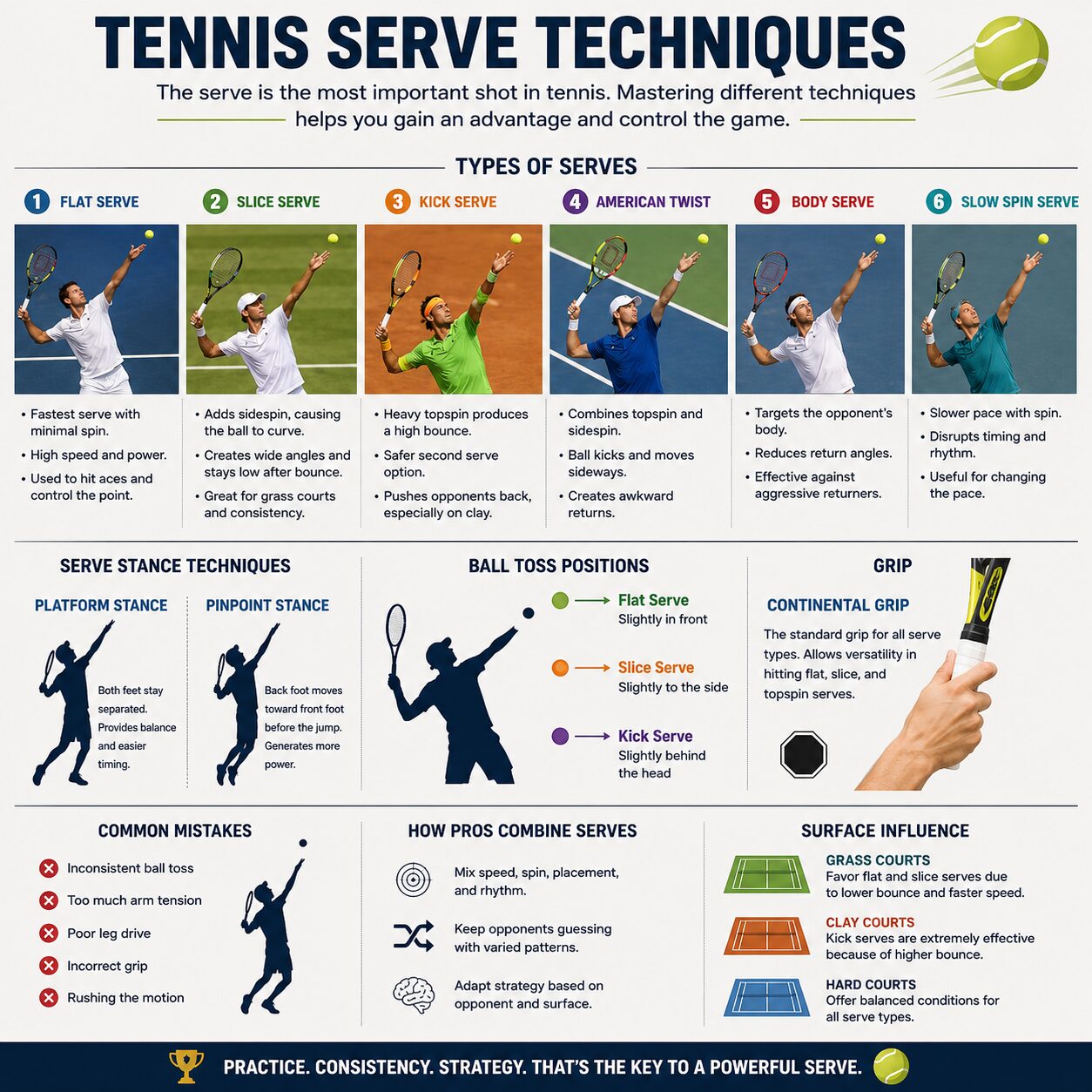
A flat serve requires precise timing and body coordination. The racket contacts the ball slightly behind or directly above the head, producing maximum forward power.
Key characteristics:
- high speed
- low margin for error
- difficult to return if placed accurately
- commonly aimed toward corners and lines
Players such as Roger Federer and Pete Sampras became known for accurate flat serves combined with strong placement.
Slice serve
 The slice serve adds sidespin to the ball. Instead of traveling straight, the ball curves through the air and moves sideways after the bounce. Right-handed players often use it wide on the deuce court to pull opponents off the court.
The racket brushes across the outside of the ball during contact. Compared to a flat serve, the slice serve is usually slower but offers better control and angle variation.
Advantages of the slice serve include:
- wider serving angles
- lower bounce on grass courts
- disruption of return timing
- improved consistency compared to flat serves
On faster surfaces such as grass, slice serves become particularly effective because the ball stays low after bouncing.
Kick serve
The kick serve uses topspin to produce a high bounce after landing. It is commonly used as a second serve because the heavy spin increases safety over the net while reducing the risk of double faults.
To generate topspin, players brush upward on the back of the ball. The contact point is often slightly behind the head, and the motion involves strong shoulder and wrist acceleration.
A kick serve can push opponents far behind the baseline, especially on clay courts where the bounce becomes more aggressive.
Benefits of the kick serve:
- high net clearance
- safer second serve option
- difficult return height
- strong control under pressure
Rafael Nadal frequently uses kick serves on clay to open the court for the next shot.
American twist serve
The American twist serve is a variation of the kick serve with additional sidespin. After bouncing, the ball moves both upward and sideways. For right-handed servers, the ball often jumps to the opponent’s backhand side.
This technique requires advanced wrist control and shoulder flexibility. Because of its complexity, it is less common among beginner players.
The twist serve is mainly used to create awkward return positions rather than pure speed.
Body serve
A body serve targets the opponent directly rather than aiming wide or toward the center line. The purpose is to limit racket extension and reduce the angles available for the return.
Body serves are effective against aggressive returners because they force quick adjustments. Many professional players mix body serves with wide serves to make their patterns less predictable.
Serve stance techniques
Tennis players mainly use two serving stances:
Platform stance
In the platform stance, both feet remain separated throughout the motion. This approach provides balance and stability.
Advantages:
- easier timing
- improved balance
- consistent rhythm
Pinpoint stance
In the pinpoint stance, the back foot moves toward the front foot before the upward jump. This technique helps generate additional power from the legs.
Advantages:
- stronger upward drive
- increased serve speed
- explosive movement
Novak Djokovic uses a pinpoint stance to combine balance with power generation.
Ball toss importance
The ball toss affects every serve type. Even small variations in toss position change spin, power, and direction.
General toss positions:
- flat serve — slightly in front
- slice serve — slightly to the side
- kick serve — slightly behind the head
Professional players train the toss separately because consistency is essential for reliable serving mechanics.
Common mistakes during serves
Many amateur players lose effectiveness because of technical errors rather than lack of strength.
Frequent problems include:
- inconsistent ball toss
- excessive arm tension
- poor leg drive
- incorrect grip
- rushing the motion
Most coaches recommend developing smooth rhythm before focusing on maximum power.
Grip techniques for serving
The continental grip is considered the standard tennis serve grip. It allows players to produce flat, slice, and topspin serves without changing hand position significantly.
Beginners sometimes use a forehand-style grip, but this limits spin generation and reduces long-term development.
How professionals combine serve types
Professional players rarely use the same serve repeatedly. Instead, they combine speed, spin, placement, and rhythm variation.
Typical combinations include:
- flat first serve followed by kick second serve
- wide slice serve to open the court
- body serve during important points
- slower spin serves to disrupt timing
Serving strategy depends heavily on the opponent’s return style and court surface.
Surface influence on serves
Court surfaces directly affect serve performance.
- Grass courts favor flat and slice serves because of lower bounce and faster speed.
- Clay courts increase kick serve effectiveness due to higher bounce.
- Hard courts provide more balanced conditions for all serve types.
Because of this, players often adjust serving patterns between tournaments.